How to Be Secular by Jacques Berlinerblau
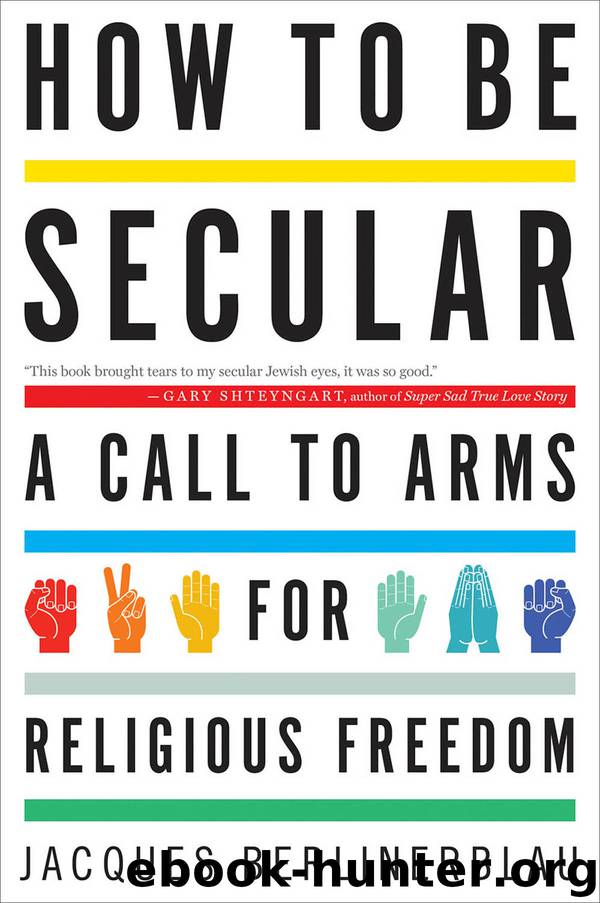
Author:Jacques Berlinerblau
Language: eng
Format: epub
Publisher: Mariner Books
Disestablishmentarianism and Accommodation
Let’s say a Frosty the Snowman wearing a Christmas wreath and holding a cross (in his little branch hand) appears in the front yard of a municipal building. Separationists swing into action. After notifying the police, the ACLU, and AU—and, if possible, the Department of Homeland Security—they conduct their own independent inquiry. That investigation reveals that federal workers in the building had formed a Christian prayer group. One fine December day, they donned mittens and hats and gamboled down the stairs of the post office to erect this impromptu monument to their Lord and Savior.
Separationists, with their long tradition of crèche activism, know exactly how to respond. Truth be told, secularists have been responding to such provocations for decades. Symbolic micro-breaches of the wall of separation always send them to the courts or the op-ed pages.
A separation threat is not an establishment threat. This point needs emphasis. Separation threats are worrisome and annoying. But establishment threats, like the congressional resolutions nixing parts of the First Amendment as noted earlier, are potentially devastating to everything we hold dear about America. The coffers of secularism are bare, its personnel is limited. The whole movement needs to set its priorities in order to respond to the challenges coming its way. Separation threats simply should not be treated as lines in the sand when Revivalists have fanned out across all three branches of government and nearly control one political party.
Might it lead to an establishment? That is the question that a besieged, understaffed secularist movement should ask about state and federal policies. In the era of the Revival this is a more pragmatic prompt than Does it entangle the state with the church? Despite the dangers of rallying people around a nine-syllable word, secularists should, for now, move away from separationism toward disestablishmentarianism.
The latter is related to, but not identical with, separationism. One of the major differences is the willingness to at least consider the merits of accommodationist arrangements. According to this view, the American government has constitutional warrant to offer nondiscriminatory assistance to religion in general. As long as federal or state authorities favor no one religion in particular, they may dispense monies or material support or symbolic recognition to faith-based groups and maintain good civic conscience.
This does not mean, by the way, that the Constitution undeniably grants that warrant. Many legal experts have expressed convincing arguments against the idea that the Founders were accommodationists. As Leonard Levy put it, “The clause meant to [the Constitution’s] framers and ratifiers that there should be no government aid for religion, whether for all religions or one church.”61
This may indeed be true. But let there be no doubt, accommodationist principles are already being enacted by federal and state governments.62 The Office of Faith-Based and Neighborhood Partnerships is a reminder of this. Statehouses around the country are entering into more and more partnerships with religious groups.63 The Supreme Court, for its part, presently retains a majority that seems not at all averse to accommodationist logic. Secularists might not like accommodation, but it is becoming a fact on the ground.
Download
This site does not store any files on its server. We only index and link to content provided by other sites. Please contact the content providers to delete copyright contents if any and email us, we'll remove relevant links or contents immediately.
| Anthropology | Archaeology |
| Philosophy | Politics & Government |
| Social Sciences | Sociology |
| Women's Studies |
The remains of the day by Kazuo Ishiguro(8998)
Tools of Titans by Timothy Ferriss(8393)
Giovanni's Room by James Baldwin(7346)
The Black Swan by Nassim Nicholas Taleb(7128)
Inner Engineering: A Yogi's Guide to Joy by Sadhguru(6792)
The Way of Zen by Alan W. Watts(6614)
The Power of Now: A Guide to Spiritual Enlightenment by Eckhart Tolle(5781)
Asking the Right Questions: A Guide to Critical Thinking by M. Neil Browne & Stuart M. Keeley(5772)
The Six Wives Of Henry VIII (WOMEN IN HISTORY) by Fraser Antonia(5514)
Astrophysics for People in a Hurry by Neil DeGrasse Tyson(5189)
Housekeeping by Marilynne Robinson(4445)
12 Rules for Life by Jordan B. Peterson(4303)
Ikigai by Héctor García & Francesc Miralles(4273)
Double Down (Diary of a Wimpy Kid Book 11) by Jeff Kinney(4268)
The Ethical Slut by Janet W. Hardy(4251)
Skin in the Game by Nassim Nicholas Taleb(4248)
The Art of Happiness by The Dalai Lama(4130)
Skin in the Game: Hidden Asymmetries in Daily Life by Nassim Nicholas Taleb(4004)
Walking by Henry David Thoreau(3961)
